The internet's standard answer to "how long does a keg last?" is some variant of "165 pints." That number is technically correct for one specific keg, one specific glass size, with zero foam loss, zero spillage, and a single drinker who doesn't change their mind.
In practice, almost no keg pours that many usable pints. Here's how to calculate it properly — both how long until the keg is empty and how long the beer stays good in the keg (different questions, different answers).
The Quick Numbers (If You Just Want a Ballpark)
| Keg Type | Volume | 12oz pours | 16oz pints | |---|---|---|---| | Cornelius (homebrew) | 5 gal / 19 L | ~53 | ~40 | | Sixtel (1/6 barrel) | 5.16 gal / 19.5 L | ~55 | ~41 | | Quarter barrel ("pony") | 7.75 gal / 29.3 L | ~82 | ~62 | | Half barrel (full keg) | 15.5 gal / 58.7 L | ~165 | ~124 |
These are theoretical maximums. Your real number will be 10-25% lower. Read on for why.
Why "165 Pints" Is a Lie
A standard 1/2 barrel keg holds 1,984 fluid ounces. Divided by a 16oz "pint" (which isn't actually a pint — a pint is 20 oz in most of the world, 16 oz being the US "pint"), that's 124 pours. Where did 165 come from?
165 assumes 12oz pours. People reach for the bigger number because it sounds better. That's the first source of the confusion.
The real number depends on four variables most articles skip:
1. Glass Size
You probably don't pour exactly 16 oz. Your homebrew tulip is 12. Your shaker pint is 16. Your Imperial pint is 20. Your "tasting" sample is 4. A bachelor party's "pour me a real one" is whatever fits in a stein.
Mixed glass sizes mean a 5-gallon corny might give you 40 pints or 80 tasters. Plan accordingly.
2. Foam and Spillage Loss
Every pour loses some volume to foam, drip, glass film, and the inch you toss out because it came out flat. A realistic loss budget per pour:
- Well-tuned home setup: 0.5-1 oz per pour
- Average home setup: 1-2 oz per pour
- First few pours of a fresh keg: 3-5 oz (foamy until it settles)
- Last few pours: mostly foam (typically 5-10% of keg volume)
Net effect: a 5-gallon corny gives you maybe 53 clean 12oz pours, but 45-50 poured-into-glasses pours. The rest goes down the drain or onto the floor.
3. Drinking Pace
Knowing how many pours you'll get is one thing. Knowing how many days the keg lasts is another. Pace varies wildly:
- Solo homebrewer: 1-3 pints/day → corny keg lasts 2-4 weeks
- Couple at home: 3-6 pints/day → corny keg lasts 1-2 weeks
- Weekend party: 30-50 pints in one night → corny keg lasts one party
- Small taproom: 60-100 pints/day → half barrel lasts ~1.5-2 days
- Brewpub on a Friday: Multiple half barrels per session
Without tracking, your guess at pace will be 30-50% off. People consistently underestimate how much they drink at parties and overestimate how much they drink on a Tuesday.
4. Time-Based Decay
Even if you don't pour any beer, the keg degrades from day one. More on this below.
Worked Example: A Saison in a Corny
Say you've got a 5-gallon corny full of saison. You drink one pint after work most weeknights, two on weekends. Friends come over occasionally and you pour 3-4 extra pints. Your beer line is dialed in well — about 1 oz of foam per pour.
Daily average: ~1.5 pints/day = 24 oz/day = ~9 oz/day in losses (on top of the 24 served).
Total daily drain: 33 oz.
5 gallons = 640 oz.
Days to empty: 640 / 33 ≈ 19 days.
If you'd just used "5 gallons / 16 oz" you'd have predicted 40 pints over 40 days. Off by half.
A Keg Doesn't Last Forever Just Because You Don't Drink It
The harder question: how long does a keg stay good once tapped?
Answer depends on three things: what kind of beer, how cold, what kind of CO2 pressure system.
CO2-Dispensed (Most Home Setups)
If you're pushing the keg with CO2 from a tank, the beer stays drinkable for 2-4 months in proper kegerator conditions (36-38°F, sealed system, clean lines).
Quality timeline:
- Weeks 1-4: Peak. Tastes like the brewer intended.
- Months 1-3: Slow decline. Hop character fades first (especially in IPAs). Malt flavors change. Most styles still good.
- Months 3-6: Noticeably worse. Hoppy beers go cardboardy. Lagers may pick up off-flavors.
- 6+ months: Drinkable for the desperate, not for guests.
Air-Tapped (Party Pumps)
If you tapped the keg with a hand pump that pushes ambient air, you're on a clock. Air = oxygen = oxidation.
- Day 1: Fine.
- Day 2-3: Still drinkable, fresh.
- Day 4+: Noticeably stale. Skunked-tasting. Throw it out by day 5-7.
Never put a hand pump on a keg you intend to drink for more than a weekend.
Style Matters
| Style | Lasts (CO2-pushed) | Notes | |---|---|---| | IPA / NEIPA | 4-8 weeks | Hop character is fragile, drink fresh | | Lager / Pilsner | 3-4 months | Cleaner profile, age shows less | | Stout / Porter | 4-6 months | Roasted character holds up well | | Saison | 6-12 months | Often improves for first few weeks | | Belgian strong ale | 1-2 years | Genuinely cellar-able | | Sour / lambic | Years | Designed to age |
A 5-gallon batch of NEIPA you brewed in March needs to be drunk by May. A Belgian quad you kegged last fall is hitting its stride.
Real-World Tracking Beats Math
The cleanest answer to "how long will this keg last?" isn't a calculation — it's data from your actual past kegs.
After three or four kegs, you'll know:
- Your actual pour size (probably not 16oz)
- Your actual loss rate (probably more than you think)
- Your actual drinking pace (probably more variable than you think)
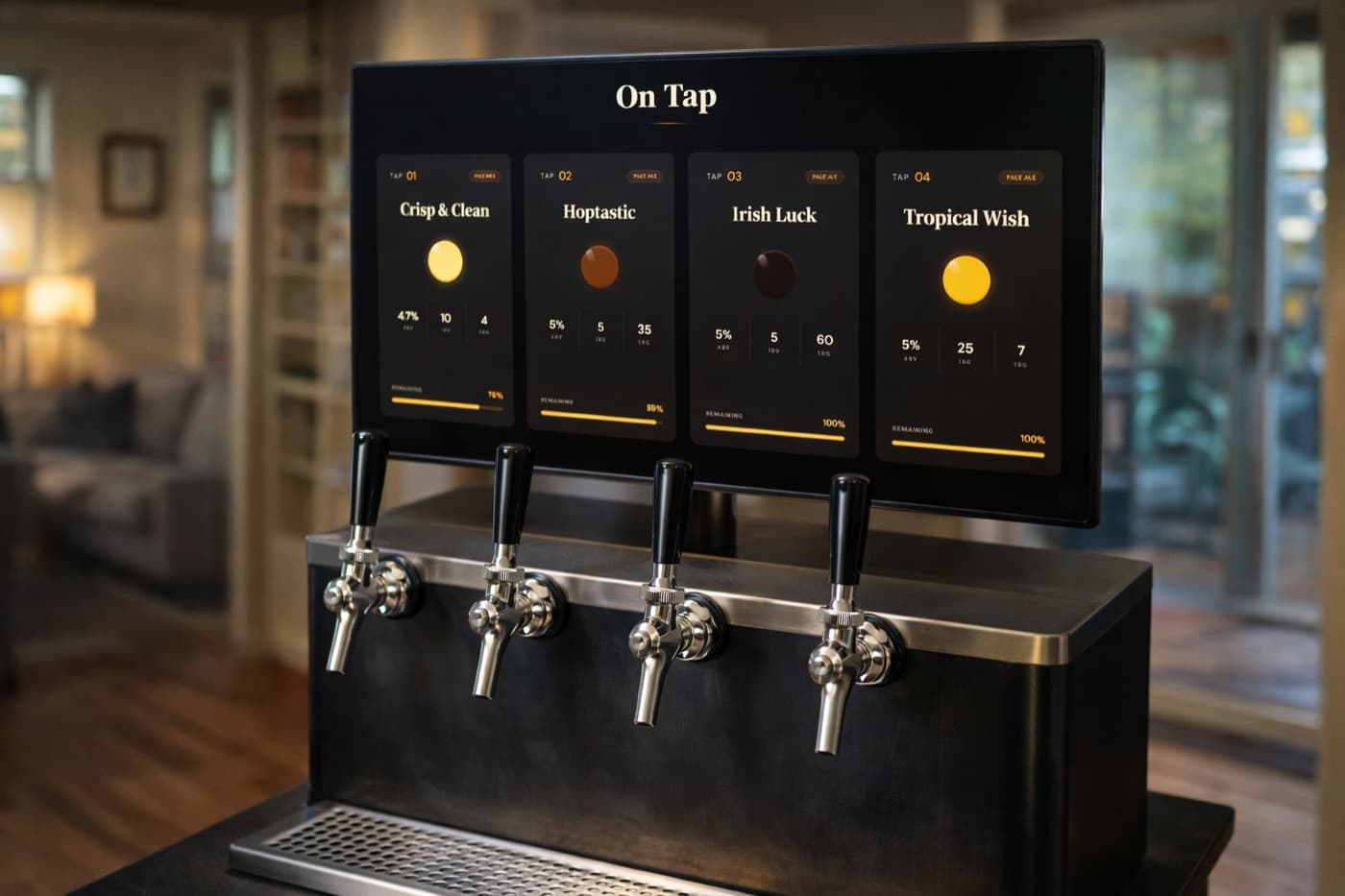
Logging pours by hand for a few weeks gets you there. So does tracking pours digitally with Keggio — pour data accumulates automatically with manual logging or a flow meter, and after one full keg, you'll have your number for the next one.
Practical Tips
- Mark the tapping date. Sharpie on the keg, or note it in your tap tracker. You can't predict shelf life if you don't know when you started.
- Estimate the keg level conservatively. "About half" usually means 30-40%. Lifting the keg by hand catches you by surprise — by the time it feels light, you've got 20% left.
- Set a low-keg alarm at 15-20%, not 5%. The last 10% pours mostly foam. Plan your next keg early.
- Cold-crash the keg before serving. A keg that hits 36°F slowly ferments out residual sugars and the resulting CO2 can over-carbonate. Settle it cold for 24 hours before tapping.
Bottom Line
If someone asks "how long does a keg last?" and they want a number, give them this: a 5-gallon corny lasts 1-3 weeks for active home use, or 2-4 months in cold storage. A half barrel at a small taproom is gone in 1-2 days.
Anything more precise requires knowing your pour size, your loss rate, and your drinking pace — three things you only learn by tracking.
So track. Pen and paper works. A digital tap list with pour logging works better. Either way, the next keg you buy will fit your reality, not the marketing math.